Community Board Bylaws
APPENDIX 4
Roberts Rules of Order – Simplified - Cornell University
Guiding Principles:
- Everyone has the right to participate in discussion if they wish, before anyone may speak a second time.
- Everyone has the right to know what is going on at all times. Only urgent matters may interrupt a speaker.
- Only one thing (motion) can be discussed at a time.
A motion is the topic under discussion (e.g., “I move that we add a coffee break to this meeting”).
After being recognized by the president of the board, any member can introduce a motion when no other motion is on the table.
A motion requires a second to be considered.
If there is no second, the matter is not considered. Each motion must be disposed of (passed, defeated, tabled, referred to committee, or postponed indefinitely).
How to do things:
You want to bring up a new idea before the group.
- After recognition by the president of the board, present your motion. A second is required for the motion to go to the floor for discussion, or consideration.
You want to change some of the wording in a motion under discussion.
- After recognition by the president of the board, move to amend by:
- adding words,
- striking words or
- striking and inserting words.
You like the idea of a motion being discussed, but you need to reword it beyond simple word changes.
- Move to substitute your motion for the original motion. If it is seconded, discussion will continue on both motions and eventually the body will vote on which motion they prefer.
You want more study and/or investigation given to the idea being discussed.
- Move to refer to a committee. Try to be specific as to the charge to the committee.
You want more time personally to study the proposal being discussed.
- Move to postpone to a definite time or date.
You are tired of the current discussion.
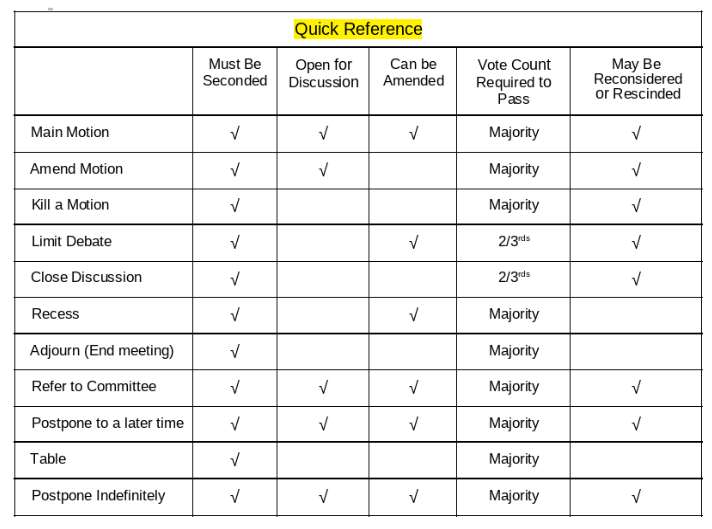
- Move to limit debate to a set period of time or to a set number of speakers. Requires a 2/3rds vote.
You have heard enough discussion.
- Move to close the debate. Also referred to as calling the question. This cuts off discussion and brings the assembly to a vote on the pending question only. Requires a 2/3rds vote.
You want to postpone a motion until some later time.
- Move to table the motion. The motion may be taken from the table after 1 item of business has been conducted. If the motion is not taken from the table by the end of the next meeting, it is dead. To kill a motion at the time it is tabled requires a 2/3 rds vote. A majority is required to table a motion without killing it.
You believe the discussion has drifted away from the agenda and want to bring it back.
- “Call for orders of the day.”
You want to take a short break.
- Move to recess for a set period of time.
You want to end the meeting.
- Move to adjourn.
You are unsure the president of the board announced the results of a vote correctly.
- Without being recognized, call for a “division of the house.“ A roll call vote will then be taken.
You are confused about a procedure being used and want clarification.
- Without recognition, call for “Point of Information” or “Point of Parliamentary Inquiry.” The chair of the board will ask you to state your question and will attempt to clarify the situation.
You have changed your mind about something that was voted on earlier in the meeting for which you were on the winning side.
- Move to reconsider. If the majority agrees, the motion comes back on the floor as though the vote had not occurred.
You want to change an action voted on at an earlier meeting.
- Move to rescind. If previous written notice is given, a simple majority is required. If no notice is given, a 2/3 rds vote is required.
Unanimous Consent:
If a matter is considered relatively minor or opposition is not expected, a call for unanimous consent may be requested. If the request is made by others, the president of the board will repeat the request and then pause for objections. If none are heard, the motion passes.
You may INTERRUPT a speaker for these reasons only:
- to get information about business
- –point of information to get information about rules
- –parliamentary inquiry
- - if you can’t hear, safety reasons, comfort, etc.
- –question of privilege
- if you see a breach of the rules
- –point of order
- if you disagree with the president of the board’s ruling
- –appeal
- if you disagree with a call for Unanimous Consent
- –object